
Architecture Overview
SoftClient4ES is a SQL gateway that translates standard SQL into Elasticsearch operations. It provides a unified GatewayApi that accepts any SQL statement and routes it to the appropriate executor.
High-Level Architecture
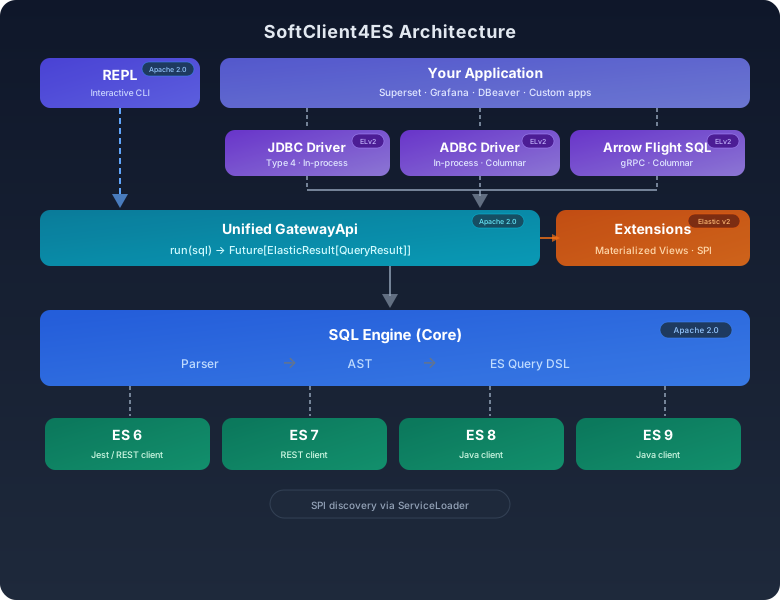
Statement Routing
The GatewayApi exposes a single entry point:
def run(sql: String): Future[ElasticResult[QueryResult]]SQL statements are automatically classified and routed:
| SQL Type | Executor | Examples |
|---|---|---|
| DQL | DqlExecutor | SELECT |
| DML | DmlExecutor | INSERT, UPDATE, DELETE, COPY INTO |
| DDL | DdlRouterExecutor | CREATE/ALTER/DROP TABLE, PIPELINE, WATCHER |
The API automatically normalizes SQL (removes comments, trims whitespace), splits multiple statements separated by ; (quote-aware — a ; inside a string literal or a -- comment is not a boundary), parses each statement into AST nodes (each must be complete on its own; leftover input is a parse error, not silently discarded), and dispatches to the correct executor. Statements run sequentially, stopping at the first failure; the last statement’s result is returned.
Result Types
DQL Results
| Type | Description |
|---|---|
QueryRows | Materialized rows (maps) |
QueryStream | Streaming rows via scroll |
QueryStructured | Raw Elasticsearch response |
DML Results
DmlResult(inserted = N, updated = N, deleted = N, rejected = N)DDL Results
| Type | Returned by |
|---|---|
DdlResult(success) | CREATE, ALTER, DROP, TRUNCATE |
TableResult(table) | SHOW TABLE |
PipelineResult(pipeline) | SHOW PIPELINE |
SQLResult(sql) | SHOW CREATE TABLE/PIPELINE |
QueryRows | DESCRIBE TABLE/PIPELINE |
Module Structure
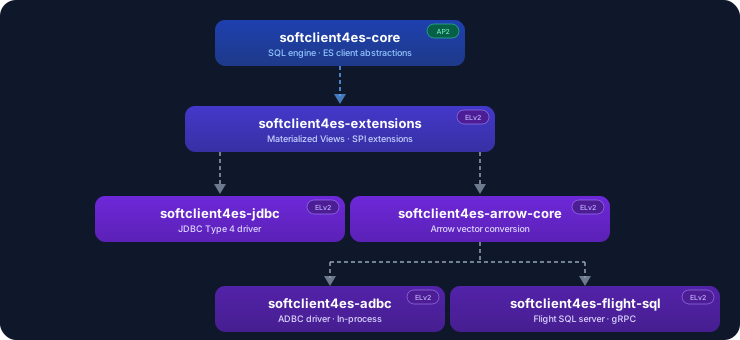
The project is organized into a multi-module ecosystem:
| Module | Purpose |
|---|---|
| Core (Apache 2.0) | SQL parser, AST, query translation, GatewayApi, REPL |
| Extensions (Elastic v2) | Materialized Views, SPI extensions |
| JDBC (Elastic v2) | JDBC Type 4 driver |
| Arrow Core (Elastic v2) | Arrow vector conversion, shared abstractions |
| ADBC Driver (Elastic v2) | In-process columnar access via ADBC API |
| Arrow Flight SQL (Elastic v2) | gRPC-based columnar server |
Client Access Methods
| Method | Process Model | Data Format | Protocol | Use Case |
|---|---|---|---|---|
| REPL | Standalone | Text (ASCII/JSON/CSV) | Direct | Ad-hoc queries |
| JDBC | In-process | Row-based (ResultSet) | JDBC API | Java apps, BI tools |
| ADBC | In-process | Columnar (Arrow) | ADBC API | Analytics, data engineering |
| Flight SQL | Separate server | Columnar (Arrow) | gRPC (HTTP/2) | Multi-client, networked |
Version Isolation
Each Elasticsearch major version has its own subproject tree (es6/, es7/, es8/, es9/). Version-agnostic code in core/ and sql/ never imports from version-specific modules. A bridge template pattern ensures code sharing across versions while maintaining isolation.
SPI Pattern
Client implementations are discovered via Java’s ServiceLoader mechanism (ElasticClientFactory), allowing clean separation between the SQL engine and Elasticsearch client libraries.
Classloader resolution
Every SPI lookup in the library (ElasticClientSpi, ExtensionSpi and the licensing LicenseManagerSpi) resolves its providers against the classloader that loaded the SPI interface — the one holding softclient4es-core and softclient4es-licensing — never the thread context classloader. The client factory’s built-in elastic.* defaults (ElasticConfig, read from softnetwork-elastic.conf) are resolved the same way. This is what lets the library run inside hosts that own the context classloader (Tableau, plugin containers, application servers) without a provider silently going missing.
Consequences:
- Ship the client, extension and licensing jars on the same classpath as the core jar — a flat classpath (
-cp core.jar:lib/*) or a single shaded jar both qualify. - A provider visible only through the thread context classloader (for example an extension jar placed on a child classloader with the context classloader pointing at it) is no longer discovered.
- An empty provider list is reported with a WARN naming the SPI interface at the two sites that used to degrade silently (
ExtensionRegistry,LicenseRefreshStrategyFactory);ElasticClientFactoryfails loudly instead, withNo ElasticClientSpi implementation found through <classloader>: the client jar must be on the same classpath as softclient4es-core ....